
Baba Is You
Baba Is You is a logic puzzle game in which you move characters, objects, and word tiles to change the rules of each one-screen level. Its documented campaign contains 481 levels across three level packs, including later stages that turn level maps into puzzles of their own.
Screenshots
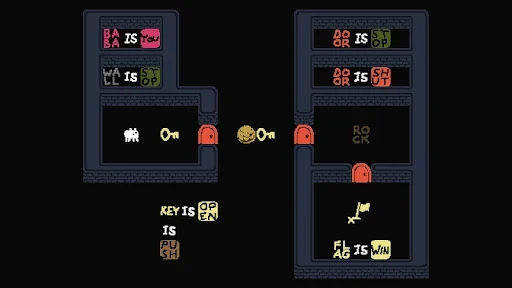
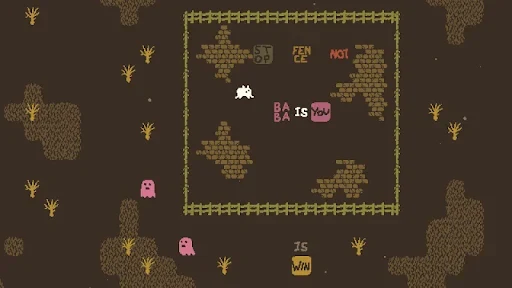
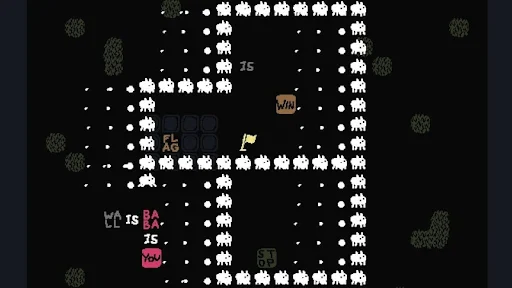
About this app
Baba Is You is a logic puzzle game centered on moving characters, objects, and word tiles to alter how a level works. Each stage presents a self-contained scene containing things such as the controllable Baba character, walls, hazards, goal objects, and text blocks. Instead of treating the environment's rules as fixed, the player rearranges those blocks to create or break statements that define control, movement, obstruction, transformation, and victory.
Build rules from word tiles
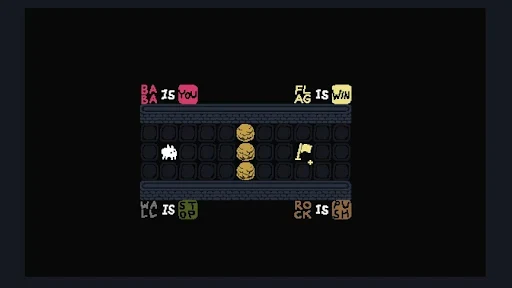
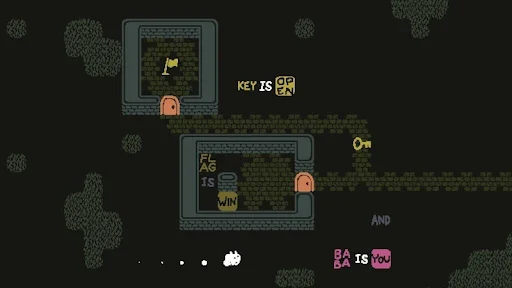
The central interaction is forming a valid sentence from at least three aligned word tiles. A typical rule combines an object, the verb IS, and a property or another object. Statements can be arranged horizontally or vertically, and they remain active while the required sequence stays connected. Moving one tile can therefore change the rule that governs an entire class of objects.
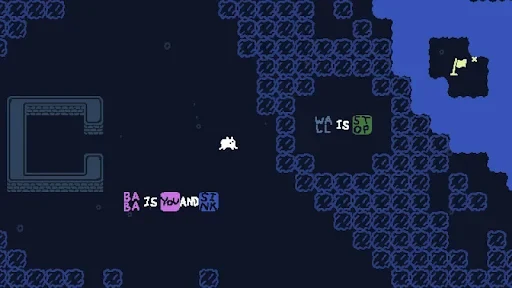
The word tiles use several roles. Nouns identify objects or hazards, including Baba, flags, walls, and other creatures. IS links the subject to its property or target. AND and NOT help form additional rule structures, while descriptive words specify how an object behaves. YOU makes instances of the named object controllable by the player. PUSH and PULL affect how objects can be moved, STOP makes an object impassable, and WIN identifies an object as a goal.
Change control and the level objective
A level is completed when an object governed by an IS YOU rule occupies the same tile as an object governed by an IS WIN rule. An object can also be both the player-controlled subject and the winning object when it is assigned both roles through the rules. This means the apparent goal is not necessarily permanent: moving IS and WIN can assign the victory condition to a different object.
The same rule manipulation can change access through the level. If an object has STOP, it is impassable; breaking the statement that gives it STOP removes that stated property. The source also describes situations in which the player can temporarily break an IS YOU rule and later restore it. Some properties, including MOVE or SHIFT, can continue functioning without a currently controlled object, allowing the player to arrange a later setup before control is re-established.
Transform objects through syntax
Rules can also declare that one object is another object by using a structure such as BABA IS FLAG. According to the documented mechanic, this replaces instances of the first object with instances of the second on the screen. A self-referential rule such as BABA IS BABA can prevent another BABA IS object transformation from taking effect. These interactions make the word arrangement itself part of the puzzle state, rather than merely a description placed around the action.
Undo, restart, and incomplete setups
There is no explicit level failure described in the source. A setup can become unable to continue when no IS YOU objects remain, or when there is no active IS YOU rule. In that situation, the player may need to undo actions or restart the level. The documented rules also allow a player to work with a temporarily broken control condition when another active property has produced a useful arrangement.
The source describes experimentation as part of the intended interaction. Players can move word blocks, separate a sentence, reconnect it in a different location, or test how the surrounding objects respond. It also notes that levels can have more than one solution, but it does not define a single general solution method for every stage. If a particular level remains unresolved, the described map structure may allow progress on another available level before returning to it.
Level packs and map-based puzzles
The game contains 481 documented levels divided among three packs. The Baba is You pack contains 231 levels, Museum contains 88 reworked and polished unused or scrap levels, and New adventures contains 162 levels added with the Baba make level update. These packs provide the setting for the same rule-editing activity while introducing different level arrangements and word interactions.
In later stages of Baba is You and Museum, the noun LEVEL becomes available. At that point, the map screens used to select stages can themselves become playable levels. The player can treat levels as objects and manipulate rules around the map to progress. This extends the central idea beyond a single room: the same syntax-based interaction can apply to the structure used to navigate between stages.
How the documented guidance approaches puzzles
The supplied guidance recommends examining the complete scene before moving anything, including the available phrases, objects, and terms that may remain fixed. It also suggests observing systems that involve moving objects so their relationships can be understood before changing the arrangement. These are descriptions of how to inspect a puzzle, not guarantees that a particular approach will solve it.
Other documented suggestions focus on trying unusual combinations of terms and objects, considering which rules can be changed, and revisiting a level after working elsewhere. Because the rules are represented by movable tiles, the supported puzzle activity is to test how different valid statements affect the scene and its objective. The game therefore presents its challenge through changing relationships between language, control, object behavior, and victory conditions.
Version history
View all23 May 2026 · stable